

September 30, 2026
OpenAI released GPT-6.1 Sol on September 29. GPT-6 Sol is AI SQL Tuner’s premium model, so we tested the new version head-to-head the day after release, on all three of our benchmarks.
Executive summary
GPT-6.1 Sol did not improve on GPT-6 Sol in either result quality or speed, even though it used about half as many reasoning tokens.
- Results: no measurable difference. On Index Tuning, Query Tuner and Code Review, the two models cut workload time by amounts inside the test system’s run-to-run noise. GPT-6 Sol had the better median on two of the three tests.
- Speed: GPT-6.1 Sol was 1.5 to 2 times slower. Its typical answer took 92 to 106 seconds, against 51 to 71 seconds for GPT-6 Sol.
- Tokens: less reasoning, more writing. GPT-6.1 Sol used 53% fewer reasoning tokens. It wrote longer reports, though, so its total billed output was 11% higher.
- Cost: slightly higher. Both models are priced the same, at $2 per million input tokens and $10 per million output tokens, so GPT-6.1 Sol’s longer output made each analysis cost about 7% more on average ($0.132 against $0.123).
- Reliability: equal. Both models went 15 for 15. Every recommended script ran without error, every rewritten query returned exactly the same results as the original, and no run made the workload slower.
On these results there is no reason to move from GPT-6 Sol to GPT-6.1 Sol.
How we tested
Each test gives a model the same pinned input: the database’s schema, workload statistics and code. The model’s recommendations are applied to a fresh copy of the database, the workload is run again, and the before-and-after difference is measured. Everything ran on a dedicated Azure VM with SQL Server 2022 Enterprise. Both models ran in the same test session on the same build of AI SQL Tuner, at medium reasoning effort (the product default), with 5 runs per model per test.
| Test | What the model is asked to do | Run-to-run noise on total time |
|---|---|---|
| Index Tuning | Index a database for an OLTP read and write workload | ±13.3% |
| Query Tuner | Make one slow query faster, given its execution plan | ±25.5% |
| Code Review | Review stored procedures and views, and fix what slows them down | ±10.3% |
A difference smaller than a test’s noise band counts as no difference. “Total workload time” is the whole workload, reads and writes together, so an index that speeds up reads but slows down writes is scored on the net result.
Results: no measurable difference
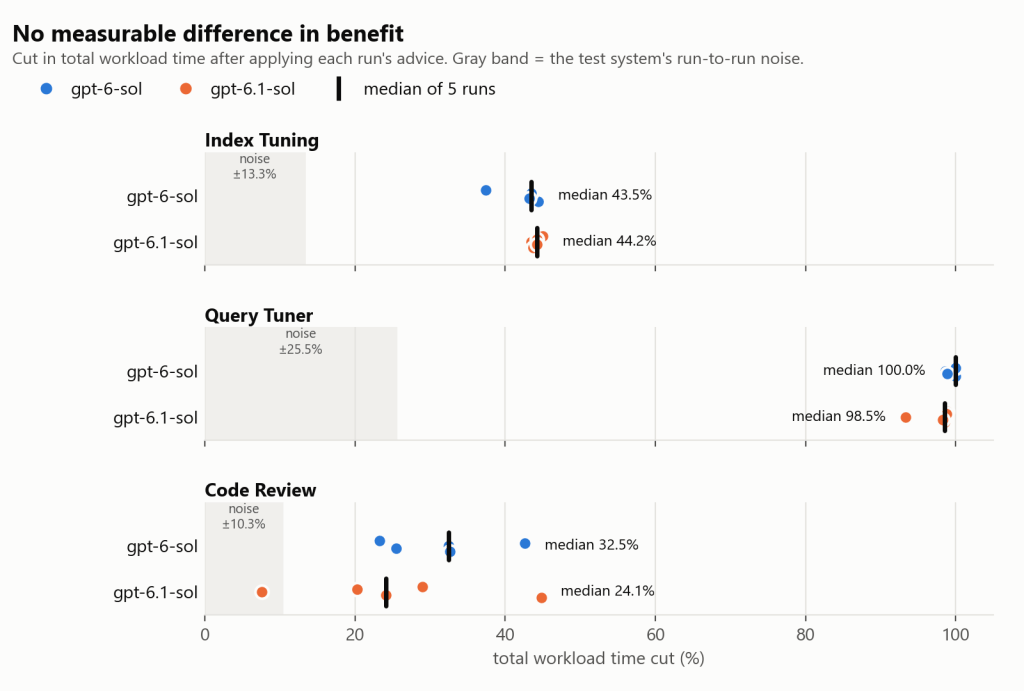
| Test | GPT-6 Sol median (range) | GPT-6.1 Sol median (range) | Gap vs noise |
|---|---|---|---|
| Index Tuning | 43.5% faster (37.4 to 44.4) | 44.2% faster (43.5 to 45.0) | 0.7 pts, inside ±13.3% |
| Query Tuner | 100.0% faster (98.6 to 100.0) | 98.5% faster (93.3 to 98.9) | 1.5 pts, inside ±25.5% |
| Code Review | 32.5% faster (23.3 to 42.6) | 24.1% faster (7.6 to 44.8) | 8.4 pts, inside ±10.3% |
- Index Tuning was a dead heat. Every run from both models found the same strong index set, cutting the data the workload reads by 79%.
- Query Tuner leaned slightly toward GPT-6 Sol. It eliminated the query’s reads entirely in 3 of 5 runs, while GPT-6.1 Sol never cut them by more than 94%. Its first run cut them by only 47%, although the query still ran 93% faster.
- Code Review is where GPT-6.1 Sol was least consistent. Its runs ranged from a 45% improvement down to 7.6%, which is inside the noise band, so that run made no measurable difference. It cut the data the reads touched more (76% against 43%). GPT-6 Sol’s fixes did more for the write side, though, and it came out ahead on total time.
Speed: GPT-6.1 Sol was 1.5 to 2 times slower

| Test | GPT-6 Sol | GPT-6.1 Sol | Slowdown |
|---|---|---|---|
| Index Tuning | 51 s | 92 s | 1.8× |
| Query Tuner | 71 s | 106 s | 1.5× |
| Code Review | 51 s | 104 s | 2.0× |
The two models did not overlap at all: GPT-6.1 Sol’s fastest run (87 s) was slower than GPT-6 Sol’s slowest (75 s). The slowdown is not explained by extra work: GPT-6.1 Sol generated tokens at about 93 per second, against 142 for GPT-6 Sol. That may improve as capacity for a day-old model grows, so response time is worth re-measuring in a few weeks.
Tokens: less reasoning, more output
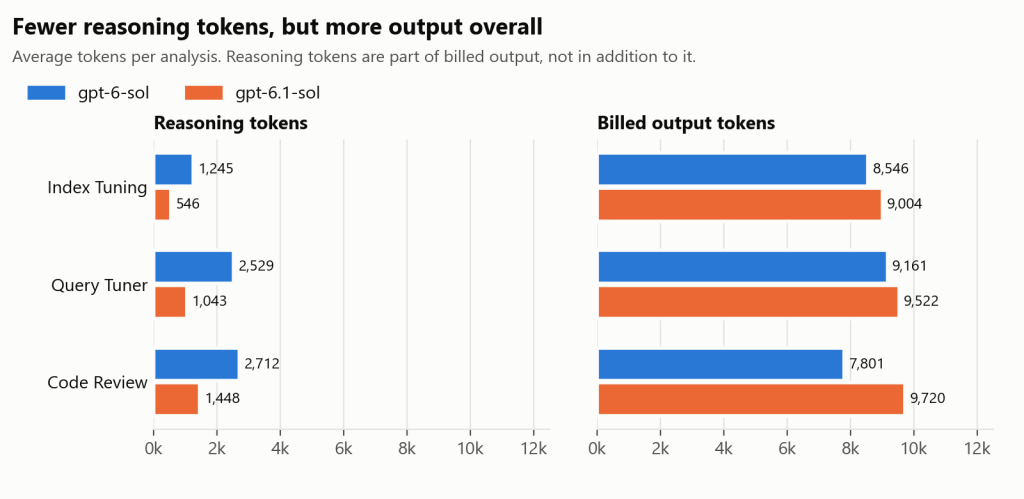
GPT-6.1 Sol reasoned much less, using 1,013 reasoning tokens per analysis on average against 2,162 for GPT-6 Sol (53% fewer). But reasoning tokens are counted inside billed output, not added on top of it. GPT-6.1 Sol spent what it saved on longer reports, so total billed output rose from 8,503 to 9,415 tokens per analysis (+11%). The gap was widest on Code Review, at 9,720 against 7,801 (+25%). Input was identical: both models received the same payload.
Cost per analysis
Both models are priced the same: $2.00 per million input tokens and $10.00 per million output tokens.
At the same price per token, fewer reasoning tokens did not make GPT-6.1 Sol cheaper, because its total output was larger.
Caveats
- Five runs per model per test. That is enough to rule out a large difference in either direction, not to rank two models that are this close. Code Review’s 8.4-point gap sits just inside its ±10.3% noise band.
- One reasoning effort. We tested medium effort, the product default. Low and high effort were not tested.
- A day-old model. Response times for a newly released model often change as the provider adds capacity. The quality results are unlikely to move; the speed results might.
Bottom line
GPT-6.1 Sol gives advice of the same quality as GPT-6 Sol. It thinks less, writes more, answers more slowly and costs slightly more per analysis. For SQL Server tuning with AI SQL Tuner, it is not an upgrade.
Frequently asked questions
Is GPT-6.1 Sol better than GPT-6 Sol for SQL Server tuning?
No. On our Index Tuning, Query Tuner and Code Review benchmarks, the two models’ improvements to workload time were within run-to-run noise. GPT-6 Sol had the better median on two of the three tests, and both models were equally reliable: no failed scripts, no wrong query results and no slowdowns in 30 runs.
Is GPT-6.1 Sol faster than GPT-6 Sol?
No, it is slower. GPT-6.1 Sol took 1.5 to 2 times as long to return its advice: a median of 92 to 106 seconds per analysis, against 51 to 71 seconds for GPT-6 Sol. Even its fastest run (87 seconds) was slower than GPT-6 Sol’s slowest (75 seconds).
Does GPT-6.1 Sol cost more than GPT-6 Sol?
The price per token is the same, at $2.00 per million input tokens and $10.00 per million output tokens. But GPT-6.1 Sol produced longer output, so each analysis cost about 7% more on average. On Code Review the gap was 21%.
GPT-6.1 Sol uses fewer reasoning tokens. Why isn’t it cheaper?
Reasoning tokens are counted as part of billed output tokens, not in addition to them. GPT-6.1 Sol used 53% fewer reasoning tokens (1,013 against 2,162 per analysis). It more than made up the difference by writing longer reports, so its total billed output was 11% higher (9,415 against 8,503 tokens).
Should I switch AI SQL Tuner from GPT-6 Sol to GPT-6.1 Sol?
Not on these results. GPT-6.1 Sol gives advice of the same quality, takes longer to return it and costs slightly more per analysis. We will re-measure response time once the model has been available for a few weeks, since speed often improves as providers add capacity for a new model.
How was GPT-6.1 Sol tested?
Both models received the same input for each test and ran on the same build of AI SQL Tuner, at medium reasoning effort (the product default), 5 times per test. The tests ran on a dedicated Azure VM with SQL Server 2022 Enterprise. After each run, the model’s recommendations were applied to a fresh copy of the database and the workload was measured again. Results are compared against each test’s measured run-to-run noise, so small differences are not reported as wins.
Leave a Reply